Thursday, 28 April 2016
Richmond Unchained nominated for Biography of the Year at British Sports Book Awards
I am delighted to announce that my book Richmond Unchained has been nominated in the Biography of the Year category at the 2016 Cross British Sports Book Awards.
This is a real honour, and I hope it means that more people will be get to learn about the amazing life story of Bill Richmond. The awards take place on 1 June at Lords Cricket Ground and highlights from the ceremony will be shown the following weekend on Sky Sports.
I'd like to take this opportunity to thank everyone who has supported me throughout the writing and publication of Richmond Unchained, particularly my family and friends, and my publishers Amberley
Tuesday, 26 April 2016
"Definitely a book with 'bottom'" - Boxing Monthly on Richmond Unchained
I am pleased to announce that my book Richmond Unchained is reviewed in the new May issue of the highly-respected Boxing Monthly magazine, which is available now via App store and other digital outlets, and in the shops from Thursday.
The review is on page 52 of the magazine and is by the magazine's long-established reviewer John Exshaw. In the interests of full disclosure I think it is important to mention I had an article about Bill Richmond published by BM last year and have also contributed articles to their website.
However I do not know Mr Exshaw and I have never met or communicated with him. Therefore, I do not believe that my contributions to BM will have influenced his review in any way, shape or form - indeed, I think it is fair to say that Mr Exshaw has a reputation within the boxing community for integrity, independence and - at times - brutal honesty. Certainly, having read his reviews for many years, I have realised that he is a very hard man to please and never defers to reputation. I can also recall at least one occasion on which he has written a very negative review about a book that had also bought advertising space in BM magazine - which I think reinforces my point that he is a truly independent and impartial voice.
Bearing this in mind, I have to say that I am delighted - and no little relieved - that Mr Exshaw's review of Richmond Unchained is a very positive one! A selection of quotes from the review are included below, and if you want to read the review in full then I urge you to get a copy of the magazine!
"Mr. Williams proves both diligent and tenacious in researching the details of Richmond's life ... as well as judicious in his assessment of the most likely course of events in the many instances in which there is conflicting evidence ... The merits, then, of Mr. Williams' book are many and manifold (including the splendid illustrations by Trevor Von Eeden), and it can be heartily recommended to pugilist-specialist readers and novices alike. ... This is definitely a book with "bottom"."
Addendum: Mr Exshaw mentions in his review that Richmond Unchained would benefit from an index and in this opinion, I agree wholeheartedly with him. Due to page constraints, which came about as a result of extra research and information about Bill Richmond that I discovered relatively late in the writing process, I had to make the difficult decision to shorten my sources / referencing section and not have an index. This decision was made to ensure my main text did not have to be edited down and so that Trevor Von Eeden's wonderful illustrations could be included. In an ideal world, I wish there had been an index. Please note though, that fuller details about my sources can be found on this blog and I intend, in time, to also publish a full index to Richmond Unchained on this blog.
Saturday, 9 April 2016
Bill Richmond?
| Bill Richmond (?) and I at the Getty Center, Los Angeles |
Jerry's fascinating theory is that the sculpture, credited by the Getty Museum and the Yale Center for British Art, as being the work of Francis Harwood in 1758, is actually a much later sculpture of ... yes! Bill Richmond!
Jerry's thesis is very convincing and very interesting ... check out his fascinating posts on the subject below:
Bust of a Man
Bust of a Man ... Alternate version
Bust of a Man, the Sequel - Bill Richmond Strikes Back
Meanwhile, this post contains Jerry's work on the historical background / context to his later work:
Follow the Money
And while I'm recommending further reading for you Richmondophiles out there, you should also check out another post of Jerry's: the first chapter of a novel he's writing about Bill Richmond. Well worth reading and a real appetiser for the full length novel to follow!
| Bill Richmond (?) in all his glory |
| The Getty's attribution - which is disputed by Jerry Leibowitz |
(Some of this post involves repetition of a previous post from January 2015, but the pix are all new!)
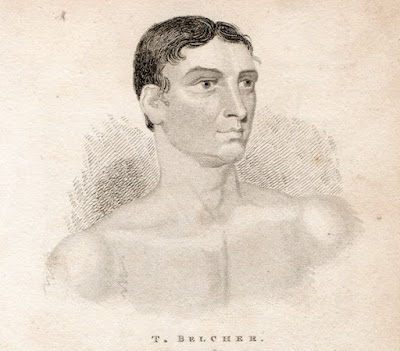
Tom Belcher grave discovered
| Tom Belcher's portrait from Boxiana |
On a visit to the cemetery on 3 April, Alex and John were able to discover the long lost grave of Tom Belcher (1783-1854) - one of the most famous boxers from the ‘golden age’ of English bare-knuckle pugilism at the beginning of the 19th century. Tom Belcher was, for many years, a close friend of Bill Richmond, subject of my 2015 book Richmond Unchained.
It has long been
assumed and reported in boxing history books that Belcher died and was buried
in his native Bristol. However recent research has revealed that he lived out
the last years of his life as a resident of number 19 Trafalgar Square,
Peckham, prior to his death and burial in Nunhead. Trafalgar Square was a well-to-do
residential area just off modern-day Commercial Way, in an area then known as
‘Peckham New Town’.
“Tom Belcher is one of the most important
fighters and players in the history of boxing and it is an absolute privilege
and honour to rediscover his grave,” Alex Joanides said. “Many thanks must also
go to The Friends of Nunhead Cemetery for their assistance in allowing us to
access their archives and cemetery layout plans and plot and grave numbers.
“The inscription of the gravestone is only
legible in certain places with other parts of the stone decayed completely
away. However, we were able to clearly make out the names of at least three
more members of the Belcher family buried in the plot.”
| Tom Belcher's grave - photo by Alex Joanides |
Born in 1783, Tom
Belcher was the brother of the great Jem, arguably the greatest boxer of the ‘Golden
Age’ period. Although Tom never became champion of England, like Jem, he was nevertheless
considered one of the most skilful boxers in the land. The legendary boxing
writer of the time, Pierce Egan, wrote of him that: “in point of elegance of
attitude and scientific precision … TOM BELCHER, as a pugilist, stands
unrivalled”.
During the first 30
years of the 19th century, boxing was the most popular sport in England and its
leading exponents among the most famous men in the country. A measure of the
fame and esteem in which Belcher - and the sport of boxing as a whole - were
held is demonstrated by the fact that he was one of the 18 famous pugilists who
were enlisted by King George IV to act as ushers at the new monarch’s
coronation in 1821. Before retiring to “country life” in the late 1820s,
Belcher was also the landlord of the famed Castle Tavern pub in Holborn for 14
years.
Belcher’s position as
a major figure from English social and sporting history has been acknowledged
through his inclusion as a character in the acclaimed 2015 novel Death and Mr Pickwick by Stephen Jarvis,
which examines the connections between The
Pickwick Papers and various facets of cultural, sporting and literary
history.
Belcher is not the
only famous boxer buried in Nunhead cemetery – the grave of the former champion
of England turned painter and musician James ‘Jem’ Ward (1800-1884) can also be
found in the grounds.
| Tom Belcher obituary from an 1855 newspaper |
Monday, 30 November 2015
The Richmond sites: Copthorne Common
![]() |
| Cribb v Molineaux descends into chaos - Art by Trevor Von Eeden |
NB: Thanks to Alex Joanides for invaluable advice and assistance with this article. Check out his website here
The Tom Cribb-Tom Molineaux prize fight that took place on 18 December 1810 at Copthorne Common in Sussex remains one of the most controversial and significant contests in sporting history. For this reason - as well as due to my fascination with the life of Richmond and the history of boxing - I have always wanted to visit the location where this contest took place, and last week this ambition was finally realised.
Before I examine the sites I visited last week that have a connection to the contest, a bit of background for the benefit of those who do not know much about the fight and its significance. In 1810, under the canny guidance and expert management of black pugilist Bill Richmond, Tom Molineaux - a former slave from the United States - electrified England's boxing landscape with a series of impressive victories. By popular demand, these wins earned him a contest with Tom Cribb, the reigning champion of All England.
Although the English sense of 'sporting fair play' recognised that Molineaux was easily the best contender to face Cribb, there was palpable nervousness surrounding the prospect of a black boxer becoming Champion of England. Lest we forget, this was an age when slavery was still in operation across the British Empire, while constant years of war with France meant that the English put great symbolic faith in their pugilistic heroes. Champions such as Cribb, Belcher, Gully et al were living symbols of the English characteristics of pluck and heart that were needed to defeat Napoleon. Therefore, for the English champion to be deposed by a foreigner - and a black one at that - was, to many, an unthinkably awful prospect. Indeed, in the build-up to Cribb-Molineaux one newspaper went as far to argue that a Molineaux victory would bring "eternal dishonour" to England.
In the event, Molineaux did not win, but he came damn close and many - myself included - firmly believe that had it not been for foul play, specifically a ring invasion, he would have been declared the winner. (The fight and its fairness or otherwise are examined in detail in my book Richmond Unchained).
As well as its socio-cultural undertones, the first Cribb-Molineaux contest was also significant in terms of sporting history, as it has a good case to be regarded as the first major international sporting spectacle of all time. True, foreign fighters had contested against English boxers in the past - for example, Bob Whitaker's contest with the Venetian Gondolier in 1733 and Frenchman Petit's bout against Jack Slack in 1754 - but these were relatively low-key contests in comparison to Cribb versus Molineaux, which attracted around 10,000 spectators and also made the pages of foreign, as well as domestic, newspapers. The first international events in football, cricket and rugby and other major sports would not occur until many decades in the future.
You would think that the location of such a historic event would be well signposted and a well-known landmark, but, sadly, that is not the case. Much of the glorious (and not so glorious!) history of boxing is unmarked and seemingly forgotten these days, and sadly the Cribb v Molineaux fight is no exception.
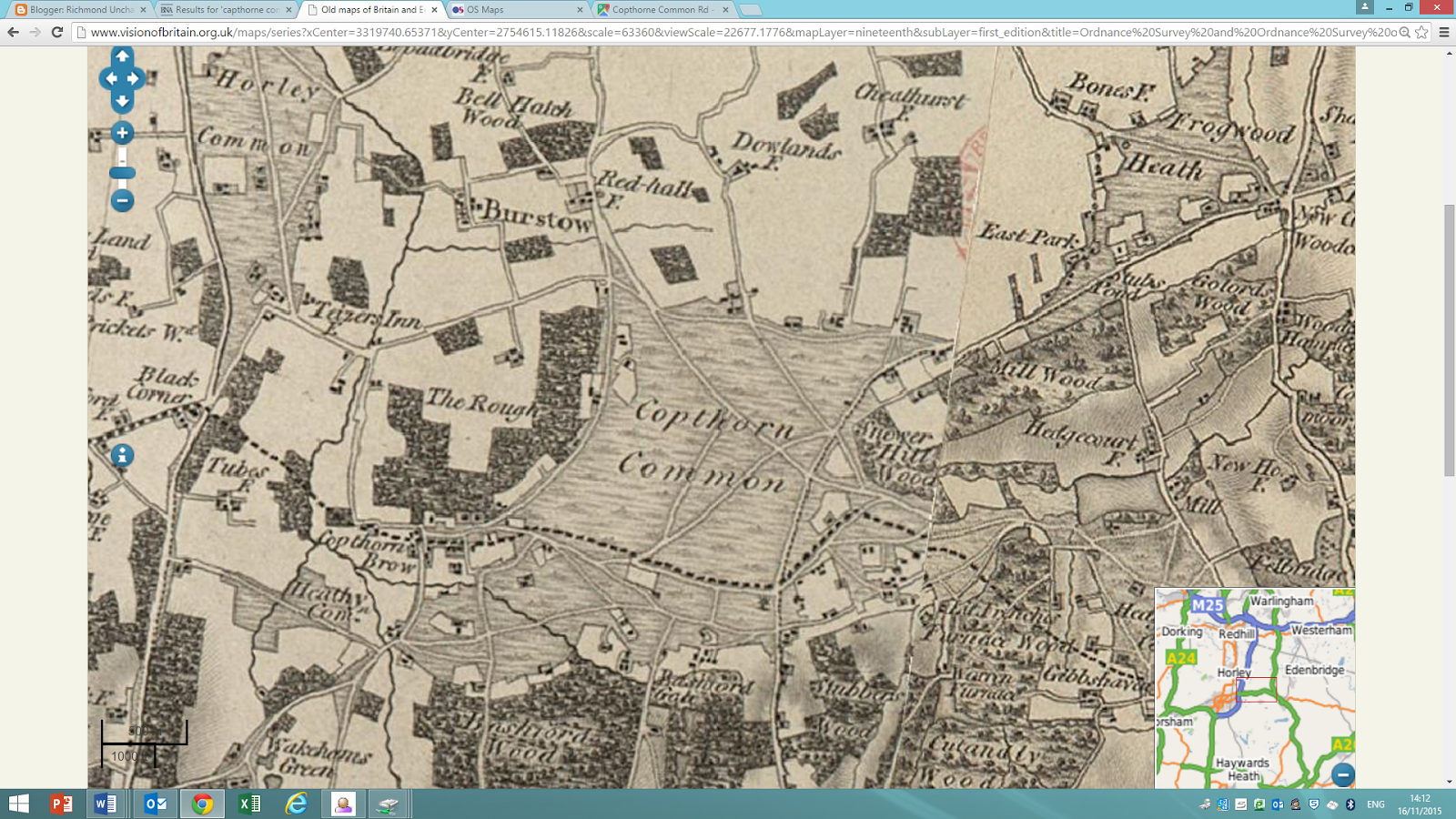
Indeed, even working out the exact location of the fight has proved to be something of a challenge! This is partly because accounts from 1810 are pretty vague concerning where exactly the contest took place. Most reports of the contest utilise the variant spelling of Copthall (as opposed to Copthorne) Common, and pinpoint the fight as having taken place in Sussex, close to the border with Surrey, with several mentioning the common's proximity to the town of East Grinstead. The screen grabs below show what the geography of Copthorne Common was like circa 1805, five years before the fight, as well as the comparative geography today. A study of these maps makes it clear that the majority of the northern area of the common no longer exists.
![]() |
| Copthorn (sic.) Common circa 1805 |
![]() |
| Copthorne Common today |
As we can see from the above maps, the modern-day A264 - also known as Copthorne Common Road - was the dividing line between the counties of Sussex and Surrey in 1810. Incidentally, the contemporary references to the fight taking place in Sussex, as opposed to Surrey are hardly surprising given the relative leniency of magistrates in Sussex towards prize fighting at this time compared to their Surrey counterparts.
Taking the geography and county border into account, it is highly likely that the location of the fight was somewhere along the south-side of what is now Copthorne Common Road.
However, where exactly?
Thankfully, contemporary sources provide us with a further, possibly decisive clue. One of the most detailed accounts of the Cribb-Molineaux fight states that: "the spot [where the fight took place] was situated nearly at the foot of a hill, which protected the combatants from the chilling wind and rain from the eastward."
Taking the geography and county border into account, it is highly likely that the location of the fight was somewhere along the south-side of what is now Copthorne Common Road.
However, where exactly?
Thankfully, contemporary sources provide us with a further, possibly decisive clue. One of the most detailed accounts of the Cribb-Molineaux fight states that: "the spot [where the fight took place] was situated nearly at the foot of a hill, which protected the combatants from the chilling wind and rain from the eastward."
Driving along the gradual downwards slope of Copthorne Common Road it is immediately evident which areas of the common fit these descriptions: namely, the area today occupied by Court House Farm and the adjacent area to the farm, which is now part of Copthorne Golf Course. The maps and photos below outline these locations.
![]() |
| The likely location of Cribb v Molineaux - either immediately south west of the road marked Court House Farm or slightly further south-west in the area now occupied by Copthorne golf course |
| The sign for Court House Farm, the possible location of Cribb v Molineaux 1 |
| Could this field at Court House Farm have been the very turf where Cribb faced Molineaux? |
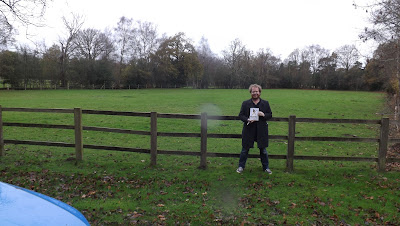
| Author Luke G. Williams at Court House Farm |
| Another view of author Luke G. Williams at Court House Farm |
Having visited Copthorne Common, I then decided to visit two other sites associated with the fight, namely the locations where the two fighters and their respective 'teams' lodged before the contest - the Dorset Arms pub in East Grinstead - where Richmond and Molineaux stayed - and the Crown in Turner's Hill - where the champion Cribb resided.
The Dorset Arms is 5.3 miles east of the fight's likely location on Copthorne Common. Driving the same route that Molineaux and Richmond would have travelled to the fight in 1810 was a wonderful experience - I even allowed myself the luxury of wondering what conflicting emotions of excitement and nervousness must have been racing through their minds as they approached their date with pugilistic destiny!
Their journey that day - most likely in a barouche and then on foot - would have been far from straightforward given the horrendous weather, as one account of the fight makes clear: "A more unfavourable day for the sport could not possibly have been selected, as it rained in torrents the whole of the day ... the last three miles of the road were almost knee-deep with clay; so that it can excite no surprise to learn that many horses were knocked up, and the riders, as well as pedestrians, never reached the place of action."
As the below images illustrate, although the frontage of the Dorset Arms has been modernised, it is clearly the same building as in the early 1900s, when it was known as the Dorset Arms Hotel. It seems unlikely that the pub would have been rebuilt between 1810 and the 1900s.
| The Dorset Arms today |
| The Dorset Arms in the early 1900s |
![]() |
| Luke G. Williams inside the Dorset Arms |
Viewing the Dorset Arms from the rear you get an idea of where the stables probably were in 1810, which possibly housed the horses which dragged Richmond and Molineaux's carriage some of the way to Copthorne Common.
| Rear view of the Dorset Arms |
Having visited the Dorset Arms, next on my list was the The Crown Pub, where Cribb stayed before defending his title.
Located in Turner's Hill, Cribb's shorter 3.4 mile journey to Copthorne Common may well mean that he was able to leave later in the morning for the fight than Molineaux was. Could this have been an often overlooked reason why his stamina appeared superior in the latter stages of the fight and he appeared less affected by the terrible weather than Molineaux? Perhaps ...
Like the Dorset Arms, the exterior of the Crown has been modernised, but the original core of the building most likely remains the same as in 1810. Although there are many fox-hunting prints on the wall, there is no recognition of the pub's pugilistic heritage, which is a real shame.
Like the Dorset Arms, the Crown has a great selection of beers and a wonderful menu. The dining area of the pub, with its low beams, gives an indication of what the interior of the pub may have looked like in 1810. I can just picture Cribb and his chief second Joe Ward huddled by the fireside while discussing tactics for the fight!
If you are a Cribb, Molineaux or Richmond fan, then a visit to Copthorne followed by visits to these two pubs, makes for a pretty enjoyable itinerary!
Sunday, 4 October 2015
Risky Regencies interview
I've been pretty busy lately, hence only sporadic updates to this website. Therefore over the next week or so I'll be fully updating the blog with some recent links and developments concerning Richmond Unchained.
The first of these updates is to let you all know about an interview which I recently conducted with the very entertaining and always interesting Risky Regencies website.
Click here to read the piece in full.
Thursday, 1 October 2015
The art of Richmond Unchained - part 1
Since the publication of Richmond Unchained I have received numerous enquiries and compliments about the book's artwork. In order to satisfy readers' curiosity I will be writing a series of articles describing the thinking behind the artwork and the process of working with the brilliant artist Trevor Von Eeden to produce it ...
From the moment I signed a contract with Amberley to publish Richmond Unchained, one of the most important, but challenging, aspects of the book I had to consider was the artwork.
The accepted convention with historical biographies is to illustrate them with a 'picture section' in the middle of the book (is there a technical name for such a section? If so, I don't know what it is!) I wanted such a section within Richmond Unchained, in order to feature the many prints and illustrations of Bill that have been produced over the years, however, this idea alone didn't satisfy me.
You see, I love the style of illustrated fiction which was so prevalent during the Georgian and Victorian eras. To me there is something inherently romantic, inventive and wonderful about Cruikshank's illustrations for Pierce Egan's Life in London, or Robert Seymour's plates in The Pickwick Papers, or Sidney Paget's Sherlock Holmes illustrations in The Strand magazine ...
![]() |
| Tom getting the best of a Charley from Life in London |
![]() |
| Seymour's plate Mr Pickwick Addresses the Club from The Pickwick Papers |
![]() |
| A Paget illustration of Holmes in fine pugilistic form |
It was a question I thought long and hard about. Eventually, I hit upon the idea of utilising the illustrated fiction convention within Richmond Unchained, but decided to use a more modern form of illustrations, namely comic- book / graphic-novel style illustrations. Thus, I hoped, the book would blend old-world charm with a more modern sensibility.
From the start, I also had the perfect artist in mind for these illustrations - the brilliant Trevor Von Eeden, whose work for DC and Marvel Comics, among others, I have always admired. Trevor also has proven form as a boxing illustrator, having created the wonderful two-part graphic novel The Original Johnson about the life of heavyweight legend Jack Johnson. This work had led me to commission him to produce illustrations for Boxiana: Volume 1, an anthology of boxing writing I published last year. (As an aside, in my dealings with Trevor - all conducted via email - I'd found him to be one of the most fascinating, reliable and trustworthy people I'd ever met, as well as one of the most talented!)
Initially my publishers were pretty ambivalent about my idea. My contract specified that Richmond Unchained would contain a certain number of illustrations, and as far as the publishers were concerned these would be in the middle of the book. When I raised the idea of further illustrations to accompany each chapter they were non-committal, pointing out that any 'extra' illustrations could possibly be accommodated, but only if my text was shortened, so that the book's overall page count was not compromised.
From the start, I also had the perfect artist in mind for these illustrations - the brilliant Trevor Von Eeden, whose work for DC and Marvel Comics, among others, I have always admired. Trevor also has proven form as a boxing illustrator, having created the wonderful two-part graphic novel The Original Johnson about the life of heavyweight legend Jack Johnson. This work had led me to commission him to produce illustrations for Boxiana: Volume 1, an anthology of boxing writing I published last year. (As an aside, in my dealings with Trevor - all conducted via email - I'd found him to be one of the most fascinating, reliable and trustworthy people I'd ever met, as well as one of the most talented!)
![]() |
| Trevor Von Eeden's rendering of Jack Johnson from Boxiana Vol 1 |
At this stage I was all too aware that I was probably going to overshoot my contracted word count by about 10,000-15,000 words, and the sane decision would have been to drop the idea of illustrations altogether. However, I couldn't shake the idea from my head. Therefore I decided to steam ahead and commission illustrations from Trevor myself. Once my publishers saw Trevor's work I was convinced that they would come around to my idea and expand my page count. If not, then I would at least have a collection of original Bill Richmond illustrations all of my own!
With the deadline for submitting the manuscript of Richmond Unchained fast approaching, I soon realised that there was not enough time to commission illustrations for every single chapter. As a compromise, I decided to aim for 18 illustrations, and sketched out a 'brief' for Trevor detailing my basic ideas for each image ...
To be continued ...
To be continued ...
Subscribe to:
Posts (Atom)