In-depth blog about former slave and boxing legend Bill Richmond (1763-1829); subject of Luke G. Williams' biography, published by Amberley in August 2015.
Showing posts with label trevor von eeden. Show all posts

Monday, 30 November 2015

The Richmond sites: Copthorne Common

Cribb v Molineaux descends into chaos - Art by Trevor Von Eeden
In the third of an occasional series, Luke G. Williams looks at some of the sites associated with Bill Richmond's life that pugilistic fans might like to visit. The series continues with a look at the locations in and around Sussex connected with the controversial contest in December 1810 between Richmond's protege Tom Molineaux and Tom Cribb for the Championship of England ...

NB: Thanks to Alex Joanides for invaluable advice and assistance with this article. Check out his website here

The Tom Cribb-Tom Molineaux prize fight that took place on 18 December 1810 at Copthorne Common in Sussex remains one of the most controversial and significant contests in sporting history. For this reason - as well as due to my fascination with the life of Richmond and the history of boxing - I have always wanted to visit the location where this contest took place, and last week this ambition was finally realised.

Before I examine the sites I visited last week that have a connection to the contest, a bit of background for the benefit of those who do not know much about the fight and its significance. In 1810, under the canny guidance and expert management of black pugilist Bill Richmond, Tom Molineaux - a former slave from the United States - electrified England's boxing landscape with a series of impressive victories. By popular demand, these wins earned him a contest with Tom Cribb, the reigning champion of All England.

Although the English sense of 'sporting fair play' recognised that Molineaux was easily the best contender to face Cribb, there was palpable nervousness surrounding the prospect of a black boxer becoming Champion of England. Lest we forget, this was an age when slavery was still in operation across the British Empire, while constant years of war with France meant that the English put great symbolic faith in their pugilistic heroes. Champions such as Cribb, Belcher, Gully et al were living symbols of the English characteristics of pluck and heart that were needed to defeat Napoleon. Therefore, for the English champion to be deposed by a foreigner - and a black one at that - was, to many, an unthinkably awful prospect. Indeed, in the build-up to Cribb-Molineaux one newspaper went as far to argue that a Molineaux victory would bring "eternal dishonour" to England.

In the event, Molineaux did not win, but he came damn close and many - myself included - firmly believe that had it not been for foul play, specifically a ring invasion, he would have been declared the winner. (The fight and its fairness or otherwise are examined in detail in my book Richmond Unchained).

As well as its socio-cultural undertones, the first Cribb-Molineaux contest was also significant in terms of sporting history, as it has a good case to be regarded as the first major international sporting spectacle of all time. True, foreign fighters had contested against English boxers in the past - for example, Bob Whitaker's contest with the Venetian Gondolier in 1733 and Frenchman Petit's bout against Jack Slack in 1754 - but these were relatively low-key contests in comparison to Cribb versus Molineaux, which attracted around 10,000 spectators and also made the pages of foreign, as well as domestic, newspapers. The first international events in football, cricket and rugby and other major sports would not occur until many decades in the future.

You would think that the location of such a historic event would be well signposted and a well-known landmark, but, sadly, that is not the case. Much of the glorious (and not so glorious!) history of boxing is unmarked and seemingly forgotten these days, and sadly the Cribb v Molineaux fight is no exception.

Indeed, even working out the exact location of the fight has proved to be something of a challenge! This is partly because accounts from 1810 are pretty vague concerning where exactly the contest took place. Most reports of the contest utilise the variant spelling of Copthall (as opposed to Copthorne) Common, and pinpoint the fight as having taken place in Sussex, close to the border with Surrey, with several mentioning the common's proximity to the town of East Grinstead. The screen grabs below show what the geography of Copthorne Common was like circa 1805, five years before the fight, as well as the comparative geography today. A study of these maps makes it clear that the majority of the northern area of the common no longer exists.
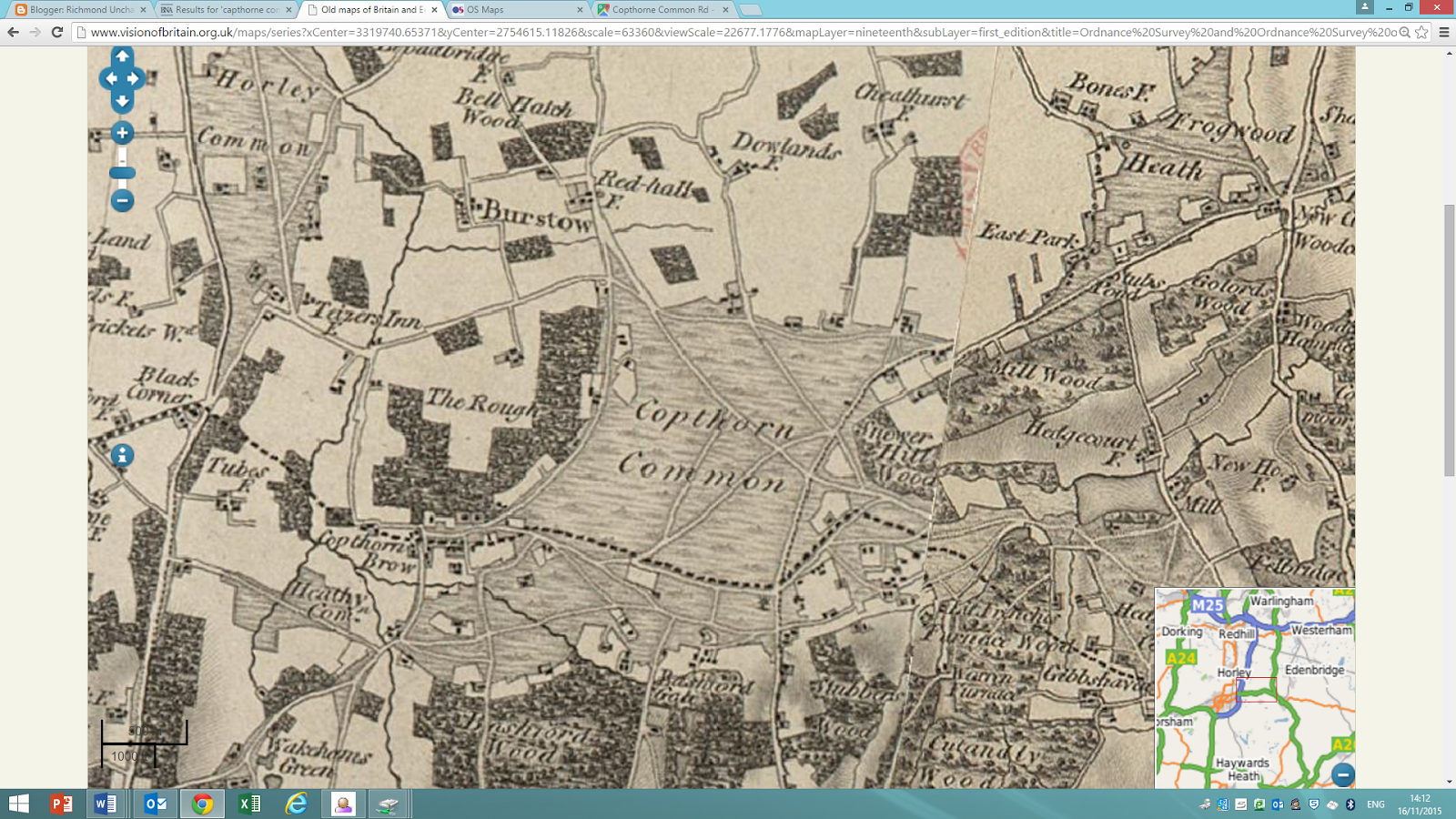
Copthorn (sic.) Common circa 1805
Copthorne Common today
As we can see from the above maps, the modern-day A264 - also known as Copthorne Common Road - was the dividing line between the counties of Sussex and Surrey in 1810. Incidentally, the contemporary references to the fight taking place in Sussex, as opposed to Surrey are hardly surprising given the relative leniency of magistrates in Sussex towards prize fighting at this time compared to their Surrey counterparts.

Taking the geography and county border into account, it is highly likely that the location of the fight was somewhere along the south-side of what is now Copthorne Common Road.

However, where exactly?

Thankfully, contemporary sources provide us with a further, possibly decisive clue. One of the most detailed accounts of the Cribb-Molineaux fight states that: "the spot [where the fight took place] was situated nearly at the foot of a hill, which protected the combatants from the chilling wind and rain from the eastward."

Driving along the gradual downwards slope of Copthorne Common Road it is immediately evident which areas of the common fit these descriptions: namely, the area today occupied by Court House Farm and the adjacent area to the farm, which is now part of Copthorne Golf Course. The maps and photos below outline these locations.

The likely location of Cribb v Molineaux - either immediately south west of the road marked Court House Farm or slightly further south-west in the area now occupied by Copthorne golf course
The sign for Court House Farm, the possible location of Cribb v Molineaux 1

Could this field at Court House Farm have been the very turf where Cribb faced Molineaux?

Author Luke G. Williams at Court House Farm


Another view of author Luke G. Williams at Court House Farm

The entrance to Copthorne Golf Course - locations in this area of the village are too high to be consistent with the original descriptions of the location of Cribb v Molineaux, however the area of the golf course south of the A264 is a good fit
Having visited Copthorne Common, I then decided to visit two other sites associated with the fight, namely the locations where the two fighters and their respective 'teams' lodged before the contest - the Dorset Arms pub in East Grinstead - where Richmond and Molineaux stayed - and the Crown in Turner's Hill - where the champion Cribb resided.

The Dorset Arms is 5.3 miles east of the fight's likely location on Copthorne Common. Driving the same route that Molineaux and Richmond would have travelled to the fight in 1810 was a wonderful experience - I even allowed myself the luxury of wondering what conflicting emotions of excitement and nervousness must have been racing through their minds as they approached their date with pugilistic destiny!

Their journey that day - most likely in a barouche and then on foot - would have been far from straightforward given the horrendous weather, as one account of the fight makes clear: "A more unfavourable day for the sport could not possibly have been selected, as it rained in torrents the whole of the day ... the last three miles of the road were almost knee-deep with clay; so that it can excite no surprise to learn that many horses were knocked up, and the riders, as well as pedestrians, never reached the place of action."

As the below images illustrate, although the frontage of the Dorset Arms has been modernised, it is clearly the same building as in the early 1900s, when it was known as the Dorset Arms Hotel. It seems unlikely that the pub would have been rebuilt between 1810 and the 1900s.

The Dorset Arms today


The Dorset Arms in the early 1900s
Sadly, the temporary residence in 1810 of two historic boxers has not been memorialised in the pub, although there are a selection of interesting historical prints on the walls, as well as a series of fine beers on tap and a good food menu!

Luke G. Williams inside the Dorset Arms


Viewing the Dorset Arms from the rear you get an idea of where the stables probably were in 1810, which possibly housed the horses which dragged Richmond and Molineaux's carriage some of the way to Copthorne Common.

Rear view of the Dorset Arms
Having visited the Dorset Arms, next on my list was the The Crown Pub, where Cribb stayed before defending his title.

Located in Turner's Hill, Cribb's shorter 3.4 mile journey to Copthorne Common may well mean that he was able to leave later in the morning for the fight than Molineaux was. Could this have been an often overlooked reason why his stamina appeared superior in the latter stages of the fight and he appeared less affected by the terrible weather than Molineaux? Perhaps ...

Like the Dorset Arms, the exterior of the Crown has been modernised, but the original core of the building most likely remains the same as in 1810. Although there are many fox-hunting prints on the wall, there is no recognition of the pub's pugilistic heritage, which is a real shame.


Like the Dorset Arms, the Crown has a great selection of beers and a wonderful menu. The dining area of the pub, with its low beams, gives an indication of what the interior of the pub may have looked like in 1810. I can just picture Cribb and his chief second Joe Ward huddled by the fireside while discussing tactics for the fight!


If you are a Cribb, Molineaux or Richmond fan, then a visit to Copthorne followed by visits to these two pubs, makes for a pretty enjoyable itinerary!

Thursday, 1 October 2015

The art of Richmond Unchained - part 1


Since the publication of Richmond Unchained I have received numerous enquiries and compliments about the book's artwork. In order to satisfy readers' curiosity I will be writing a series of articles describing the thinking behind the artwork and the process of working with the brilliant artist Trevor Von Eeden to produce it ...

From the moment I signed a contract with Amberley to publish Richmond Unchained, one of the most important, but challenging, aspects of the book I had to consider was the artwork.

The accepted convention with historical biographies is to illustrate them with a 'picture section' in the middle of the book (is there a technical name for such a section? If so, I don't know what it is!) I wanted such a section within Richmond Unchained, in order to feature the many prints and illustrations of Bill that have been produced over the years, however, this idea alone didn't satisfy me. 

You see, I love the style of illustrated fiction which was so prevalent during the Georgian and Victorian eras. To me there is something inherently romantic, inventive and wonderful about Cruikshank's illustrations for Pierce Egan's Life in London, or Robert Seymour's plates in The Pickwick Papers, or Sidney Paget's Sherlock Holmes illustrations in The Strand magazine ...
Tom getting the best of a Charley from Life in London

Seymour's plate Mr Pickwick Addresses the Club from The Pickwick Papers
A Paget illustration of Holmes in fine pugilistic form
All of which got me thinking about whether such a style of 'letterpress plus illustrations' could work in a modern biography ...

It was a question I thought long and hard about. Eventually, I hit upon the idea of utilising the illustrated fiction convention within Richmond Unchained, but decided to use a more modern form of illustrations, namely comic- book / graphic-novel style illustrations. Thus, I hoped, the book would blend old-world charm with a more modern sensibility.

From the start, I also had the perfect artist in mind for these illustrations - the brilliant Trevor Von Eeden, whose work for DC and Marvel Comics, among others, I have always admired. Trevor also has proven form as a boxing illustrator, having created the wonderful two-part graphic novel The Original Johnson about the life of heavyweight legend Jack Johnson. This work had led me to commission him to produce illustrations for Boxiana: Volume 1, an anthology of boxing writing I published last year. (As an aside, in my dealings with Trevor - all conducted via email - I'd found him to be one of the most fascinating, reliable and trustworthy people I'd ever met, as well as one of the most talented!)

Trevor Von Eeden's rendering of Jack Johnson from Boxiana Vol 1
Initially my publishers were pretty ambivalent about my idea. My contract specified that Richmond Unchained would contain a certain number of illustrations, and as far as the publishers were concerned these would be in the middle of the book. When I raised the idea of further illustrations to accompany each chapter they were non-committal, pointing out that any 'extra' illustrations could possibly be accommodated, but only if my text was shortened, so that the book's overall page count was not compromised.

At this stage I was all too aware that I was probably going to overshoot my contracted word count by about 10,000-15,000 words, and the sane decision would have been to drop the idea of illustrations altogether. However, I couldn't shake the idea from my head. Therefore I decided to steam ahead and commission illustrations from Trevor myself. Once my publishers saw Trevor's work I was convinced that they would come around to my idea and expand my page count. If not, then I would at least have a collection of original Bill Richmond illustrations all of my own!

With the deadline for submitting the manuscript of Richmond Unchained fast approaching, I soon realised that there was not enough time to commission illustrations for every single chapter. As a compromise, I decided to aim for 18 illustrations, and sketched out a 'brief' for Trevor detailing my basic ideas for each image ...

To be continued ...

Sunday, 15 March 2015

Richmond Unchained: illustrations in progress


As Richmond Unchained nears completion, here is a glimpse of some of the preliminary and original artwork by Trevor Von Eeden which, once complete and inked, will grace the book. (Click on the image to see a larger version! The only illustration not by Trevor is the cover design in the top left-hand corner, which uses Dighton's original etching of Bill Richmond)

Trevor is a renowned artist who has worked for Marvel and DC Comics among other outlets, as well as being the writer-artist behind the brilliant graphic novel The Original Johnson. He has produced some truly amazing work for Richmond Unchained, recreating many crucial scenes and characters from Bill Richmond's life, which I can't wait to see in print.

The final versions of these illustrations will appear in the book when it is published in August. A selection of original prints of Bill and his contemporaries, the majority sourced from my own private collection, will also feature in the book. Until then I thought you'd enjoy this sneak peek of what Trevor has been working on.

Oh yes, and here's a reminder of what this project is all about!


RICHMOND UNCHAINED:
The biography of the world’s first black sporting superstar
By Luke G. Williams

Today the name of the bare-knuckle boxer Bill Richmond is largely unknown to the wider public, but he is one of the most significant sportsmen in history and was one of the most celebrated celebrities of the Georgian era. The fact no biography has ever been devoted to Richmond is startling, for the story of his life and career is a compelling and thrilling tale, played out against the backdrop of a series of significant historical events.

As one of the first black men to survive and thrive in white-dominated English society, Richmond is long overdue recognition as one of the key figures in sporting as well as social history. Born into slavery in Staten Island, New York during colonial rule, Richmond escaped from a life of servitude by winning his freedom as a young boy and carved a new life for himself in England as a cabinet-maker and then a renowned and widely respected prize-fighter and trainer.

From his humble origins, Richmond, through force of will and personality, fought his way to the top table of British society, ultimately fulfilling an official role at the coronation celebrations of King George IV in 1821. Richmond’s amazing life encompassed encounters and relationships with some of the most prominent men of the age, including the progressive Earl Percy, the writer William Hazlitt, the dissolute Prince Regent and the wild and untameable Lord Camelford.

The story of Bill Richmond is not only an incredible tale of personal advancement and triumph, but also the story of a life which was shaped, informed and influenced by a series of turbulent historical events – including the American War of Independence, the fight for black emancipation and Britain’s long-running conflict with the Emperor of France, Napoleon Bonaparte.

Luke G. Williams’ biography, the first full-length account of Richmond's life, utilises over a decade of research on both sides of the Atlantic, revealing details, sources and new facts about Richmond’s life that have never before been published. In separating myth from fact and legend from reality, for the first time, the full story of Bill Richmond’s life and times is brought gloriously to life.

Richmond Unchained will feature illustrated material from the Georgian period, as well as new and exclusive illustrations by acclaimed American artist Trevor Von Eeden.

Saturday, 3 January 2015

Best ever veterans: No. 1 Bill Richmond


Given that this blog is devoted to Bill Richmond, it was crushingly obvious that this 'best ever veterans' series would culminate in the naming of, yes, Bill Richmond as my No. 1 all-time boxing veteran! (Mind you, I'm not totally biased; as you'll discover later this year, Richmond doesn't come top of my countdown of the best bare-knuckle boxers ever).

Anyway, without further ado, I'll explain why I've ranked Bill ahead of George Maddox (my no. 5 veteran), Archie Moore (no. 4), George Foreman (no. 3) and Bernard Hopkins (No. 2).

1. Bill Richmond:
Unlike my articles about Maddox, Moore, Foreman and Hopkins, I'm going to avoid writing a potted biography of Richmond by way of justifying his position at the top of my chart. Instead, I've summarised the main reasons why I believe Bill to be the greatest boxing veteran of all time under a quartet of headings. Feel free to tweet your reactions to this series of articles @boxianajournal or email me directly at lgw007@yahoo.com

A: Low life expectancy:
In Georgian times, when Richmond was living in England, it has been estimated that the average life expectancy was somewhere between 40 and 47 years. Admittedly, this figure was hugely skewed by the large percentage of citizens who died in childhood, but it is still the case that a man who was in his 40s or 50s in Georgian England was more or less equivalent to someone in their 50s or 60s today. Taking this into account, it is truly remarkable that all of Richmond's major bare-knuckle bouts took place after he had already passed his 40th birthday. Can you imagine a modern-day boxer beginning his career aged 40-plus and going on to become one of the top pugilists around? Well, that's what Richmond did.


B: Incredible self-control:
The sort of expert and detailed medical and nutritional information available in the 21st century, which has helped boxers such as Bernard Hopkins to prolong their careers, simply didn't exist in the Georgian era. As writer William Hazlitt put it, the "whole art of training" in bare-knuckle days merely consisted of "two things" - "exercise and abstinence, abstinence and exercise, repeated alternately and without end". As this analysis suggests, Richmond didn't have the benefits of vitamin supplements, body fat reports, 'super foods' et al to aid his training and preparation; instead, he kept himself  in fighting condition through sheer bloody-minded dedication and the near elimination of alcohol from his diet. Although he enjoyed the odd glass of drink, especially noyau (a French brandy made from nut kernels), Richmond was uncommonly abstemious, a particularly impressive feat when you consider the fact he was a pub landlord for several years and that bare-knuckle pugilists were constantly surrounded by, and often immersed in, alcohol. Indeed, it seemed that pretty much every top pugilist during the Georgian era was a pub landlord at one time or another, while many - Jem Belcher, Henry Pearce and Tom Molineaux among them - died early and, most likely, alcohol-induced deaths. In contrast, when Richmond was past his 50th birthday Pierce Egan observed that while "other pugilists have long previously retired from the scenes of action, the spirits of RICHMOND seem in such trim, that, with all the ardency of youth, he is still 'eager for the fray.'" Egan also pointed out that Richmond preferred "exercise" rather than "too frequent repetition of the charms of the bottle". To display such self-control in an age of excess, marks Richmond out as an exceptional man.

C: Great victories in his 50s:
Something that distinguishes Richmond from the other fighters in my top 5, and which, in my view, seems him overhaul their achievements in the 'veteran stakes', is the fact that unlike Hopkins (whose last significant victory to date, against Beibut Shumenov, came aged 49) or Foreman (45 when he beat Moorer, 48 when he beat Lou Savarese in his last defence of the linear Heavyweight title), Richmond achieved two notable victories in his 50s. In May 1814 he defeated Davis (aka the navigator) in 13 rounds in what was the first contest organised by the earliest ever boxing governing body the 'Pugilistic Club', while in August 1815 he secured arguably the best win of his career, a 23-round triumph against highly-rated Tom Shelton, a pugilist around half his age. I am aware of no other boxer in the long history of boxing who achieved two victories against well-regarded contenders when in their 50s. No wonder that Egan was moved to write, after Richmond's triumph against Shelton, that he was an "extraordinary man" and that "the older he grows, the better pugilist he proves himself."

D: Uncrowned champion?
Some might think that a mitigating factor against Richmond being ranked as the greatest boxing veteran of all time is the fact that he never won the world title (or the English Championship, which was in his era the most prized achievement in the sport, boxing having not yet become a truly global sporting phenomenon). Although it may be true that Richmond never received official recognition as champion, there is a case for arguing that he should have been recognised as such. Let's look at the evidence for such a claim. For starters, it's worth remembering that after his defeat against Tom Cribb in 1805, Richmond was never beaten again for the rest of his career - an eight-fight streak that extended from his next contest in 1808 until his aforementioned victory against Shelton in 1815. The recognised champion during this time was, of course, Cribb. However it's worth pointing out that after defeating Richmond's protege Tom Molineaux for the second time in 1811, Cribb never fought again, although he didn't officially cede the title until almost ten years later, in 1821. These days, such a spell of ridiculous inactivity would have seen Cribb stripped of his crown. If Cribb had been stripped then I would argue that Richmond was the most logical contender to be crowned champion, or at least to participate in a contest for the vacant crown. (There was a precedent for the passing of recognition from one fighter to another due to inactivity - in 1807, when Henry Pearce failed to face John Gully for a second time, recognition of the title of 'Champion' passed pretty much universally to Gully - despite the fact he had never won a major fight!)

Tom Cribb


Even more interestingly, there was a contest involving Richmond that you can argue - admittedly a little tenuously -  should have earned Richmond recognition as champion. By 1818, with Cribb still inactive, some within the Fancy believed that Lancastrian pugilist Jack Carter - who had beaten leading contender Tom Oliver in an epic contest - should be regarded as champion, partly because Cribb had failed to answer challenges from both Oliver and Carter. Carter's claim for the championship was pretty devastatingly rebuffed by none other than Richmond on the evening of 12 November 1818. After cross words were shared between Carter and several other pugilists in a pub in Chancery Lane, Richmond took on Carter in a street fight, destroying him after just three rounds when he laid him out cold with a stupendous right hand. Had this contest been fought 'officially' in a roped ring, then Richmond could, with some justification, have claimed he was the English Champion. By this point in his career, Bill was an incredible 55 years old and the victory against Carter extended his unbeaten run to ten years and nine fights. Incidentally, Carter went on to lose his next major fight the following year to Tom Spring after 71 rounds (68 rounds longer than it took Richmond to dispose of him - although, in the interests of full disclosure, I should point out that Carter later claimed he was drunk when Richmond laid him out). Spring was later handed the title by Cribb when the 'champion' finally retired. However, considering Richmond went unbeaten from 1808 until 1818 (if you include the Carter contest), perhaps the title should have passed to him, or at the very least he should have been matched against Spring with the winner recognised as champion.

So while Richmond was never regarded as champion, he has a good case to be recognised as the premier pugilist in England between 1808 and 1818 - a period when he was aged between 45 and 55. What an achievement! And what a veteran!

Tom Spring

Bill Richmond on a postage stamp ... well, sort of ...


Well, sort of ... Royal Mail have a nifty little facility on their website which allows you to customise your own stamp designs. Well, sort of ... in actual fact you choose an existing stamp design and then your image goes as a sticker alongside it, rather than as the actual stamp itself. (I guess this is to prevent subversive images being placed on 'official' stamps bearing the Queen's silhouette ... Use your imagination!)

Anyway, I couldn't help but try it out and upload a Bill Richmond image - a cropped version of one of the magnificent illustrations drawn by Trevor Von Eeden for my upcoming book Richmond Unchained. The resulting design appears at the top of this page, and I must say it looks pretty wonderful. I chose the stamp entitled 'England's Glory' to go alongside the image of Bill - given that he spent the majority of his life and career in England and served as an usher at the coronation of King George IV I thought that was somehow appropriate. (Although we must also bear in mind the irony that Bill would never have been born a slave in the first place had the British not accelerated the slave trade from the latter half of the 17th century onwards).

Now all I have to do is persuade Royal Mail that Bill Richmond deserves an official stamp of his own. This year would be an appropriate time for him to be so honoured - it being 200 years since his remarkable victory against Tom Shelton in his last 'official' bare knuckle contest.

Did you know, by the way, that Richmond-Davis, Bill's penultimate bout, took place on 3 May 1814, the very same day it was announced that Arthur Wellesley, one of the heroes of the Peninsular War and later Waterloo, was to be given the title of 'Duke of Wellington'? Waterloo-based anniversary celebrations are set to dominate Britain this year - I hope that people also take a few moments to remember Bill Richmond too.

The Duke of Wellington and Bill Richmond both celebrate significant 200th anniversaries this year

Thursday, 1 January 2015

Best ever veterans: No. 2 Bernard Hopkins


One of the most remarkable things about Bill Richmond's career was that he was still fighting in his 50s (and this during an age when life expectancy was far lower than it is today).

Richmond's amazing longevity got me thinking about who I would rank as the greatest veterans in fistic history (including bare-knuckle days, as well as the gloved era). 

With apologies to the likes of Bob Fitzsimmons, Jersey Joe Walcott and many other admirable vets who didn't quite make the cut, George Maddox was my no. 5 choice, Archie Moore came in at no. 4 and George Foreman was my no. 3. Today I present my no. 2 ... 

2. Bernard Hopkins:
Hopkins is Bill Richmond's spiritual heir.

As well as his formidable powers of determination and fitness, Hopkins' supreme  technique, particularly defensively, are an echo of Richmond's unparalleled mastery of 'boxing on the retreat' during the Georgian bare-knuckle era.

One of the secrets of Richmond's longevity was his impressive level of self-control and an avoidance of the type of hard-drinking lifestyle that prematurely curtailed the careers of many of his contemporaries. As Pierce Egan once stated, Richmond possessed "a temperate mode of living, preferring exercise to wasting his time, or injuring his constitution, by a too frequent repetition of the charms of the charms of the bottle."


Hopkins utilises a similar philosophy.

"When you look at the things I do," the Philadelphia native commented recently. "The lifestyle and the discipline, you would say I'm preserved ... well-kept."

An expert in nutrition (he swears by boiled beets and buffalo meat), Hopkins also indulges in frequent facials, manicures and pedicures to keep him as young as possible in both body, mind and spirit.

It's this tender loving care of his impressively sculpted frame, even when between bouts, that has enabled Hopkins to assemble a host of achievements which are the stuff of boxing legend.

The Hopkins story began in harsh and unforgiving environs. Involved in street crime from his early teenage years, Hopkins had been stabbed three times by the time he was 17 and was sent to prison after a string of criminal convictions, including for armed robbery.

Future prospects for the youngster looked bleak indeed. However, while inside he discovered the redemptive powers of boxing and of religion, converting to Islam. Released after nearly five years, the governor of Graterford State Penitentiary was convinced Hopkins would soon be back, quipping, "I'll see you again," as the 23-year-old departed. Hopkins' response? "I ain't ever coming back."

After his release, Hopkins entered the pro boxing ranks, losing his professional debut in 1988, but then putting together a 21-fight unbeaten streak which only snapped when he lost to the great Roy Jones in a scrap for the vacant IBF title in 1993.

Two years after this setback, Hopkins was IBF champ courtesy of a victory against Segundo Mercado, after climbing off the canvas twice in their first contest, which ended in a draw. Hopkins defended the IBF belt a remarkable 12 times before memorably unifying the WBC, WBA and IBF straps with victories against Keith Holmes and Felix Trinidad, who most judges thought would prove too strong and hard-hitting for Hopkins.

By this stage in his career, Hopkins was already 36, but there were still many more peaks for him to conquer. He defended the unified Middleweight title six times, including an unforgettable KO of Oscar De La Hoya, to add the WBO belt to his list of belts, and also set a new middleweight division record of 20 successful title defences.

As Hopkins entered his 40s a pair of losses to Jermain Taylor saw most people ready to write his career obituaries. However, a move to light-heavyweight revitalised the Executioner's career and, over the next few years, he annexed further world titles with  victories against Antonio Tarver, Jean Pascal, Tavoris Cloud and Beibut Shumenov, overhauling George Foreman's record as the oldest world boxing champ in the process.

Although the likes of Joe Calzaghe and Chad Dawson got the better of Hopkins, he always rebounded from such losses with impressive victories and his achievement in winning light-heavy titles at the ages of 42, 46, 48 and 49 is truly remarkable.

Only Sergey Kovalev, in Hopkins' most recent bout in November 2014, has succeeded in soundly pummelling him, and it remains conceivable that Hopkins could become the first ever boxer to win a world title in his 50s. He will reach his half century in a couple of weeks time (on 15 January 2015), and only a fool would write off the fistic phenomenon that is Bernard Hopkins just yet.

Saturday, 27 December 2014

Best ever veterans: No. 3 George Foreman

George Foreman was World Heavyweight Champion twice - two decades apart

One of the most remarkable things about Bill Richmond's career was that he was still fighting in his 50s (and this during an age when life expectancy was far lower than it is today).

Modern great Bernard Hopkins is, in a sense, Richmond's spiritual heir; a man of impressive self-control and dedication to the pugilistic arts who is still boxing despite his 'advanced' years.

Hopkins' recent acts of age-defying derring-do have, unsurprisingly, provoked much discussion and admiration. Although Sergey Kovalev widely outpointed the 49-year-old in November, Hopkins' achievements in winning a succession of 'world' championship fights in his late 40s is both notable and praiseworthy.

Richmond and Hopkin's amazing longevity got me thinking about who I would rank as the greatest veterans in fistic history (including bare-knuckle days, as well as the gloved era). 

With apologies to the likes of Bob Fitzsimmons, Jersey Joe Walcott and many other admirable vets who didn't quite make the cut, I've been counting down my top five.

Earlier this week I explained why George Maddox was my no. 5 choice and Archie Moore my no. 4. Today I present my no. 3...

3. George Foreman:
F. Scott Fitzgerald wrote: "I once thought that there were no second acts in American lives, but there was certainly to be a second act to New York's boom days." In boxing terms, we can substitute 'George Foreman' for 'New York', for no pugilist has ever enjoyed such a dramatic 'second act' in his career as the 'Punchin' Preacher'.

In his fearsome, youthful pomp, 'Big George' was one of the most feared heavyweights of all time; a big, bad bogeyman who bludgeoned his way to 40-0 and the Heavyweight Championship while barely breaking into a sweat and wearing a seemingly omnipresent scowl.

However, Foreman's world fell apart in 1974 when he was on the receiving end of the magical fists and unparalleled mind games of Muhammad Ali in Zaire. By 1977, after a points loss to Jimmy Young, Foreman had quit boxing and found God.

Ten years later, needing money to support the youth centre he had founded, a tubby and now 38-year-old Foreman risked becoming a laughing stock when he launched an improbable comeback.

Despite widespread scepticism, he strung together a 24-fight winning streak (admittedly against largely weak opposition) that earned him a 1991 shot against then Heavyweight Champ Evander Holyfield. Foreman's stout and brave, but ultimately futile, challenge against the 'Real Deal' won him affection and admiration in fairly equal measure.

But the Foreman story was still not over.

Foreman kept fighting and three-and-a-half years later, new champ Michael Moorer alighted on Foreman as a lucrative but low-risk opponent for his first defence of the crown. In round ten of a contest he was losing, Foreman detonated an explosive short right-hand on Moorer's unexposed chin, the champion crumbled to the canvas and, at the age of 45 and a full two decades after losing the title to Ali, Foreman was once again World Heavyweight Champion.

It's an achievement that is so staggering, that twenty years later, it still seems unbelievable, as well as utterly inspirational. Foreman once claimed: "you've got to make a statement with your life. Otherwise you are just existing."

For Foreman, these words weren't just empty rhetoric - he lived them.